Monday, 12 March 2012

Rising Damp - first run audience figures

A quick look at the ratings for Eric Chappell's sublime ensemble comedy Rising Damp, originally shown on ITV between 1974 and 1978.

Rigsby (Leonard Rossiter) and Miss Jones (Frances de la Tour).  Sitcom poetry.
The series started life as 'The Banana Box', a stage play which Yorkshire Television head of light entertainment John Duncan saw and commissioned as a pilot when it flopped in the West End in 1973.

"[I]n a big Shaftesbury Avenue house like the Apollo it seems painfully thin, as if a television Comedy Playhouse had been stretched on the rack to go the requisite two hour distance."
Michael Billington, The Guardian (26 June 1973)

Newspaper ad for 'The Banana Box's pre-West End run at the Hampstead Theatre.  Leonard Rossiter played not Rigsby, but Rooksby in the stage play.
A series was developed before the pilot had been shown but, like Only Fools and Horses...., it was not an immediate success.

Remember that until August 1977, Audits of Great Britain, whose JICTAR system recorded weekly ratings, measured audiences in terms of millions of homes rather than viewers.  The BFI suggests multiplying by 2.2 to arrive at a figure approximating viewers.

Chart positions are probably as good a method of comparison as any.


Pilot (2nd September 1974)
Monday at 8pm, opposite on BBC1 European Athletics Championships.

'The New Tenant' - 6.15m (11th for the week)

"[O]ne of those exercises in which the parts added up to even more than the whole ... If Rossiter in particular can keep this up, and is given the scripts, we should have a gentle treat to look forward to."
Peter Fiddick, The Guardian (3 September 1974)

This was the first in a series of six pilots intiated by incoming YTV Head of Comedy Duncan Wood.  One other series resulted - Oh No - It's Selwyn Froggitt! with Bill Maynard.


Series 1 (13th December 1974-17th January 1975)
Fridays at 8.30pm, opposite Ken Dodd's World of Laughter (episodes 1-2 and 4), 1961 feature film El Cid (ep 3) and sitcom Second Time Around starring Michael Craig (eps 5 and 6)

1. 'Black Magic' - not in Top 20
2. 'A Night Out' - not in Top 20
3. 'Charisma' - not in Top 20
4. 'All Our Yesterdays' - 6.50 (15th)
5. 'The Prowler' - 7.10 (15th=)
6. 'Stand Up and Be Counted' - 6.95m (17th=)

"There are so many factors that make it a paragon of funnies.  Firmly based in a human situation, garlanded with topical pokes and timeless ones, it is fully exploited by a marvellous cast."
Tom Holt, The Stage and Television Today (23 January 1975)

Labour MP Tom Pendry sued Yorkshire Television over series 1 finale "Stand Up And Be Counted", which originally featured a Labour candidate with the same surname.  All references to the character's name are removed in the extant version.

Series 2 (7th November - 19th December 1975)
Fridays at 7.30pm, opposite US imports The Invisible Man, starring David McCallum (episodes 1-4) and repeats of The Wonderful World of Disney (eps 5-7)

1. 'The Permissive Society' - not in Top 20
2. 'Food Glorious Food' - not in Top 20
3. 'A Body Like Mine' - not in Top 20
4. 'Moonlight and Roses' - not in Top 20
5. 'A Perfect Gentleman' - 7.05m (15th)
6. 'The Last of the Big Spenders' - 7.30m (13th=)
7. 'Things That Go Bump in the Night' - 7.25m (16th)

The Invisible Man seems to have been stronger competition than The Wonderful World of Disney, though he never appeared in the Top 20.

"...Leonard Rossiter as Rigsby, the passionately inquisitive landlord, forever hovering on the fringe of his tenants' lives like an avaricious crow..."
Sylvia Clayton, The Daily Telegraph (8 November 1975)

Philip (Don Warrington) and Rigsby fight in 'A Body Like Mine'.
To the victor - a date with Miss Jones!

Christmas Special (26th December 1975)
Boxing Day at 7.45pm, opposite 1970 film The Railway Children

'For The Man Who Has Everything' - not in Top 20

Stage commitments prevented Frances de la Tour appearing in the latter half of Series 2.  Gay Rose stepped in as new tenant Brenda.

Series 3 (12th April - 24th May 1977)
Tuesdays at 8.30pm, opposite the penultimate series of long-running police drama Z Cars.  With a midweek slot, suddenly everything clicked.

1. 'That's My Boy' - 7.85m (5th)
2. 'Stage Struck' - 8.40m (5th)
3. 'Clunk Click' - 8.45m (5th)
4. 'The Good Samaritans' - 8.25m (3rd)
5. 'Fawcett's Python' - 8.40m (3rd)
6. 'The Cocktail Hour' - 8.05m (2nd)
7. 'Suddenly at Home' - 8.20m (1st)

"[N]ot since the association of Tony Hancock with Galton and Simpson has such a comic-tragic figure emerged.  Rigsby is a delightful fool and the characters spread around him by producer Ronnie Baxter add so well and unobtrusively to the humour."
James Thomas, Daily Express (13 April 1977)

Peter Bowles guest starred as resting actor Hilary in 'Stage Struck', which won Series 3 the BAFTA for Situation Comedy of 1977

Series 4 (4th April - 9th May 1978)
Tuesdays at 8.00pm, opposite new BBC Scotland drama serial The Standard starring Colette O'Neil and Patrick Malahide.  No Richard Beckinsale in this last run - he was busy with West End musical comedy "I Love My Wife" and Porridge sequel Going Straight.

1. 'Hello Young Lovers' - 18.20m (2nd)
2. 'Fire and Brimstone' - 18.55m (1st)
3. 'Great Expectations' - 18.25m (1st)
4. Pink Carnations' - 17.80m (1st)
5. 'Under The Influence' - 16.90m (2nd)
6. 'Come On In, The Water's Lovely' - 15.10m (6th)

"The series has been a personal triumph for Leonard Rossiter.  He plays it so frantically that at times it seems he'll spoil everything by going right over the top.  But he knows just what he is doing and always stops short by a hairsbreadth."
Peter Knight, The Daily Telegraph (11 May 1978)

Just the three regulars in Series 4, but it moves so fast no one would notice.
So Rising Damp came to an end after four series, its reputation forever intact.  Eric Chappell moved on to hospital comedy Only When I Laugh starring James Bolam, which proved almost as popular.


The Movie (UK release: 14 February 1980)

UK quad poster for the modestly budgeted film version, directed by Joe McGrath.  Christopher Strauli played art student John, standing in for Richard Beckinsale, who passed away on 19th March 1979.
"It feels like three telly segments gummed back to back and confirms that the most dreaded words associated with a TV series today are 'The Movie'."
Alexander Walker, Evening Standard (14 February 1980)

The inevitable feature film version premiered on ITV on Thursday 3rd March 1983, 7.45-9.30pm. Shown opposite Top of the Pops, The Kenny Everett Television Show, the first episode of documentary series The Paras and the Nine O'Clock News, 12.20m tuned in (12th for the week).

Saturday, 3 March 2012

ONLY FOOLS and HORSES.... A broadcast history (part 4): 1988-89

What many consider the very pinnacle of Only Fools was just around the corner but to backtrack a little, Series 5 was repeated 10th Sept to 15th Oct 1987, Thursdays at 8.30pm.  Aside from a blip caused by being up against ITV's premiere of Romancing the Stone (14.2m, 3rd for the week against "From Prussia With Love" with 6.5m, 57th for the week), the usual 13m or so tuned in.

These repeats didn't make BBC1 Northern Ireland - we got them on Fridays at 8pm, on BBC2.  Presumably some regional programme took precedence.  The gall!

And as mentioned the first series finally got a repeat, six years down the line, when following on from the single showing of "Big Brother" in April, the other five episodes were shown mid-October 1987 - albeit during daytime.

BBC One's daytime schedule had launched a year earlier, in late October 1986, a development which brought Australian soap Neighbours into the zeitgeist.  So why throw the show away in such a slot, when repeats were a guaranteed smash?  Was it felt by everyone that Series 1 wasn't up to the usual standards?  Or that the theme tune would be too jarring?  One can only speculate, but I think I only watched one in this run.  I've no idea why - I absolutely loved the show, and we certainly had a VCR.  I have a feeling I thought it was substandard.  Or perhaps I was particularly busy at school at the time (hey, anything's possible).

Episode 3 of Series 1, 'Cash & Curry' - I think this is the one and only episode I watched from the 1987 afternoon repeats.  Why isn't Lennard Pearce in it?  Was it originally planned that Grandad wouldn't always feature?  If so, thankfully they changed their minds.
Controversial Christmas '86 episode "A Royal Flush" was reshown Sunday 6th December, winning 13.2m, 10th for the week.  In its original 76 minute form, I believe this was seen on terrestrial telly only once more, in 1992.

Into 1988, and apparently it was possible the show was over.  This was presumably John Sullivan's decision as David Jason was particularly keen for the programme to return; a reversal of a couple of years before when it was Jason who had considered calling it a day.

But with Dear John.... and Just Good Friends no longer in production, it would be 1992 before Sullivan created a new show.  Instead, he concentrated on Fools exclusively for the next few years - other than adapting some of his scripts for the US version of Dear John, starring Judd Hirsch of Taxi fame (and which ran to four seasons).  Funnily enough, as I write this, another Taxi alum has been cast in the new US version of Only Fools - Christopher Lloyd is playing Grandad.

Anyway, back to 1988 and the UK and a fairly swift repeat of Christmas '87 special "The Frog's Legacy" on Tuesday 28th June garnered 9.4m (15th for the week).

Tessa Peake Jones as Raquel in 'Dates': "I don't think John Sullivan had any intention of making her a regular character... I only ever saw it as a one-off appearance" [quoted in The Complete A-Z of Only Fools and Horses by Richard Webber, Orion 2002]
The decision to recommission the show was a late one on the BBC's part, for whatever reason.  Production on Series 6 began on Sunday 6th November with the scenes at Waterloo Station where Del meets Raquel for the first time, in Christmas Day episode "Dates".  This was a little later than planned, thanks to David Jason working on A Bit of a Do for Yorkshire Television - the beginning of his long-term association with the ITV franchise holder and one which eventually did not suffer Fools gladly.

Here is where the sitcom format was revolutionized: the schedule had been locked in to the usual, three or four weeks filming followed by weekly rehearsal/recording of 30 minute episodes.  But John Sullivan was turning in very long scripts...  To cut a long story short, the BBC were happy to promote Fools to a 50 minute format in view of its huge success; actors' fees were renegotiated accordingly, but nothing could be done about the schedule.

And so over the next couple of months, cast and crew produced an 80 minute special and six 50 minute episodes and by all accounts nearly killed themselves doing so.  With transmission of the seven week run beginning at Christmas, they ended up only one week ahead in recording.

But the results were glorious.  Maybe all studio audience sitcom should be made thus.

"Dates" introduced Raquel, a winning performance by Tessa Peake Jones, a serious girlfriend for Del and a welcome stab at moving the series on.  The episode has been cited by John Sullivan as his very favourite, everything paying off beautifully.  I won't demur, it's wonderful.  Shown on Christmas Day 1988 at 5.05pm opposite the too-late premiere of The Empire Strikes Back on ITV, it got 16.6m (7th for the week).

The series proper started a couple of weeks later with "Yuppy Love" on Sunday 8th January at 7.15pm.  Competition was Roy Walker quiz Catchphrase and LWT wartime drama Wish Me Luck.  Meanwhile on BBC1, Del boy was giving us his own catchphrase - and falling through a bar.

"Breakfast is for wimps" - Del-boy in his Gordon Gekko phase.  Wall Street was released in the UK in late April 1988.  The genius of John Sullivan to react accordingly.
Yes, would you believe me if I told you it was with this episode that Del's most recognisable catchphrase originated?  Eight years, six series and 41 episodes in, he said "lovely jubbly" for the first time.  He had also, hilariously, become a yuppy, having watched Michael Douglas in Wall Street.  Such fresh and promising schick from such a well established character is one reason why the show, after all this time, was still winning converts.

I've got nothing much to say on the subject of Del falling through the bar.  It was funny, and has certainly played its part in the programme's placement in the popular culture.  But it's been recycled so often as to attract ridicule.  And the chandelier gag is funnier.


"Yuppy Love" also introduced Gwyneth Strong as a love interest for Rodney, Cassandra Parry.  Nicely underplayed by the actress, the comic business involving the pair of them - Rodney pretending to live in the exclusive King's Avenue since she's dropping him off and he wants to make an impression - is every bit as inspired as the bar scene.

Cassandra: "You've taken my coat.  This one's yours"/ Rodney: "How'd you know it was mine?"/ Cassandra: "It's got your name written in it".  Del-boy embarrasses Rodney at his first meeting with Cassie and he's not even there!
Their romance developed over the six weeks, bringing a serialised element to the show for the first time, more akin to Just Good Friends than Fools and Horses.  I'm sure this played its part in the immense popularity of this series.  Had we been served up another 6 individual half-hours, I doubt the impact wouldn't have been the same.

And the impact was considerable.  Everyone was watching the show at this time.  In addition to the whole falling through the bar thing, who can forget "Danger UXD" (great title) about 'Lusty Linda' and 'Erotic Estelle', the blow-up dolls filled with propane; or "The Unlucky Winner Is..." with Rodney winning a Mega-Flakes competition, an all-expenses paid holiday to Spain - except, the organisers think he's 14; and finally, "Little Problems" when in a bittersweet ending Rodney ties the knot with Cassandra, finally leaving Nelson Mandela House, and Del-boy, for the life he's always wanted.

Ultimately, I still think the half-hours are the ones which shine brightest as comic jewels, but no one can question the marvellous second wind these longer episodes generated just when the show would almost certainly have started to flag.

Ratings were through the roof - an average of 16¾m, with the last episode reaching 18.9m.  Reviews couldn't be anything but positive.  If this was intended to be the end, reaction put paid to that.

A deserved BAFTA for "Comedy Series of 1988".  One of five wins for the programme, out of 17 nominations between 1983 and 1996.  Still not enough.
The show won a BAFTA for Best Comedy Series that March, officially for "Dates" as being shown in 1988 it was the only one eligible.  As a result it got a very fast repeat, Sunday 2nd April at 7.15pm - 15.1m tuned in, 8th for the week.

Series 6 got its first repeat 8th September to 13th October 1989, Fridays around 8pm.  An average of almost 13m, and never out of the Top Ten.  For the first time, I have little or no recollection of this, probably because the concept of video tape was so firmly entrenched that I had already watched the episodes a gazillion times.  In fact I still have the off-airs now.  Also, this straddles my going to University so I may have been otherwise occupied.


Albert, Del and Rodney on "The Jolly Boys' Outing" to Margate.  It doesn't really get any better than this.  Go watch.
A glorious year for the show was rounded off with Christmas Day special "The Jolly Boys' Outing", actually recorded in May on the heels of the series.  A much-loved episode, this tale of the Peckham regulars' disastrous beano to Margate was a showcase for the entire ensemble, many of whom I don't think I've mentioned here: Roger Lloyd Pack as slow-witted Trigger; John Challis as supercilious car salesman Boycie; Paul Barber as the luckless - any time Del is around - Denzil; Roy Heather as unhygienic cafe owner Sid; Kenneth McDonald as downtrodden Nag's Head manager Mike; Patrick Murray as Rodney's untrustworthy mate Mickey Pearce; and Denis Lill as Cassandra's dad, Alan.  It's about as much fun as actually going out for the day with these guys.

Shown at 4.05pm, the special cracked the twenty million mark for the first time - 20.12m viewers, opposite a new animated version of Roald Dahl's The B.F.G. (voiced by David Jason) on ITV.  A fitting end to the decade which had introduced us to the Trotters.

John Sullivan's work on these eight episodes is a textbook example of refreshing an ageing brand.  Indeed, he had put nary a foot wrong with the show yet.  47 episodes, almost all of them brilliant.

The next decade brought quite a bit more Fools, and most of its biggest audiences, but unfortunately not to the same very high standards we had so far enjoyed.

Next time: 1990-1993, the last years of regular production, and still plenty of high points but the superlatives will be less plentiful.

Thursday, 9 February 2012

The JAMES BOND films: UK audience facts & figures


Sean Connery 
Dr. No
(1962, directed by Terence Young)

"There's never been a British film like Dr. No since...what?" 
Richard Whitehall, 'Films and Filming' November 1962.

BBFC classification: "A" - Adult (13 August 1962)
UK cinema release: 5 October 1962
Box office: n/k*
Admissions: n/k - at least 4 million
1962 total cinema admissions: 395 million
1962 average ticket price: 2 shillings 10½ pence (14p)

ITV premiere: Tue 28 October 1975, 8pm
Audience: 10,500,000 homes** (No. 1 in the week's ratings)

* "Within a few months, the picture practically recouped its production costs [approx. £400,000] in London alone" - 'When the Snow Melts: The Autobiography of Cubby Broccoli' with Donald Zec (Boxtree, 1998: p.177)
According to The Hollywood Reporter 14 Dec 1962, pic had grossed $1.66m (approx. £592k) in Britain in nine weeks of release, from 478 engagements.

** Until August 1977, weekly presentation of TV audience data in the UK was given in terms of millions of homes rather than individuals.

James Bond debuted on ITV in 1975 after a £850,000 deal with United Artists.  TV Times dated 25-31 October.


Sean Connery 
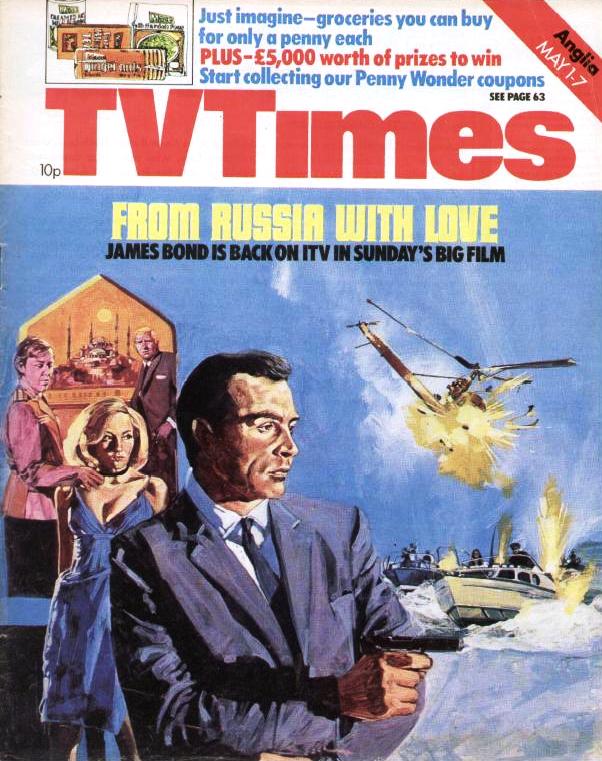
From Russia With Love
(1963, directed by Terence Young)

"The sequence before the credits is so good that anyone but the James Bond filmmakers might be frightened they couldn't top it."
Penelope Gilliatt, 'The Observer' 13 October 1963

BBFC classification: "A" (7 Oct 1963)
UK cinema release: Thursday 10 Oct 1963
Box office: n/k
Admissions: n/k
1963 total cinema admissions: 357.2 million
1963 average ticket price: 3s 1d. (15p)

ITV premiere: Sunday 2 May 1976, 7.55pm
Audience: 9,200,000 homes (No. 1 in the week's ratings)


TV Times 1-7 May 1976

From Russia With Love is to date the only Eon Productions Bond film to be screened by the BBC.  It was shown on BBC Two as part of a British Film season Sunday 29 July 2007 at 9pm, watched by 2.65m

Rogue production Never Say Never Again (1983), which saw Sean Connery return to the role of 007, was shown on BBC One a couple of times in the mid-90s.


Sean Connery
Goldfinger
(1964, directed by Guy Hamilton)

"The script by Richard Maibaum and Paul Dehn crackles with literate wit and Hitchcock surprises." 
Alexander Walker, 'Evening Standard' 17 September 1964

BBFC classification: "A" (31 August 1964)
UK cinema release: 17 September 1964
Box office (approx.): £2.33m
Admissions (approx.): 13.9 million
1964 total cinema admissions: 342.8 million
[Percentage of total admissions: 4.05%*]
1964 average ticket price: 3s 4¼d. (17p)

ITV premiere: Wed 3 November 1976, 8pm
Audience: 9,800,000 homes (No. 1 in the week's ratings)

* This figure can't possibly be accurate but it must be in the right direction.

The series continued to draw phenomenal audiences on ITV for decades.  A screening of Goldfinger on Sunday 21 April 1985 won 17.05m, and was No.2 in the ratings.


Sean Connery 
Thunderball
(1965, directed by Terence Young)

"The film is jolly to watch, especially in its submarine moments, but the toys have clearly taken over." 
Kenneth Tynan, 'The Observer' 2 January 1966

BBFC classification: "A" (7 December 1965)
UK cinema release: 29 December 1965
Box office (approx.): £2.95m
Admissions (approx.): 15.6 million
1966 total cinema admissions: 288.8 million
[Percentage of total admissions: 4.78%]
1966 average ticket price: 4s 9½d. (21p)

ITV premiere: Sat 26 February 1977, 8pm
Audience: 8,600,000 homes
(No. 7 in the week's ratings - not fully networked)

26 Feb-4 Mar 1977.  Main pic from Diamonds Are Forever, not Thunderball


Sean Connery
You Only Live Twice
(1967, directed by Lewis Gilbert)

"The picture's saving grace is Sean Connery, who ambles through the proceedings with the cheeky contempt of an arts sixth-former on a compulsory school tour of a nuclear power station." 
Philip French, 'The Observer' 18 June 1967

BBFC classification: "A" (18 May 1967)
UK cinema release: 12 June 1967
Box office (approx.): £1.81m
Admissions (approx.): 8.3 million
1967 total cinema admissions: 264.8 million
[Percentage of total admissions: 3.13%]
1967 average ticket price: 4s 4¼d. (22p)

ITV premiere: Sunday 20 Nov 1977, 7.45pm
Audience: 20,800,000 viewers (No. 1 in the week's ratings)

Never trust a man who doesn't like browsing old TV listings mags


George Lazenby
On Her Majesty's Secret Service
(1969, directed by Peter R. Hunt)

"[A] film with far more human action than in most recent Bonds.  And a lot more zip and pow, not to mention zowie, inside the action."
Alexander Walker, 'Evening Standard' 18 December 1969

BBFC classification: "A" (5 December 1969)
UK cinema release: 18 December 1969
Box office (approx.): £750,000 (No. 1 for 1970)
Admissions (approx.): 2.45 million
1970 total cinema admissions: 193 million
[Percentage of total admissions: 1.14%]
1970 average ticket price: 6s 1½d. (31p)

ITV premiere: Mon 4 September 1978, 7.30pm
Audience: 16,800,000 (No. 1 in the week's ratings)


Sean Connery
Diamonds Are Forever
(1971, directed by Guy Hamilton)

"Anyone who needs a story to enjoy this great rollicking fantasy would, no doubt, keep the stone and throw away the peach." 
Donald Zec, 'Daily Mirror' 30 December 1971

BBFC classification: "A" (6 December 1971)
UK cinema release: 30 December 1971
Box office: n/k (No. 1 for 1972)
Admissions: n/k
1972 total cinema admissions: 156.6 million
1972 average ticket price: 38p

ITV premiere: Christmas Day 1978, 6.45pm
Audience: 14,400,000 (No. 12 in the week's ratings)


Roger Moore
Live and Let Die
(1973, directed by Guy Hamilton)

"Will James Bond live on in the 1970s?  Not much longer, if this episode is anything to go by." 
John Russell Taylor, 'The Times' July 1973

BBFC classification: "A" (13 June 1973) 
UK cinema release: 6 July 1973
Box office (approx.): £3.89m (No. 1 for 1973)
Admissions (approx.): 9 million
1973 total cinema admissions: 134.2 million
[Percentage of total admissions: 6.71%]
1973 average ticket price: 43p

ITV premiere: Sun 20 January 1980, 7.45pm
Audience: 23,500,000 (No. 1 in the week's ratings)

The biggest TV audience of them all.  Well, it's such fun!


Roger Moore 
The Man with the Golden Gun
(1974, directed by Guy Hamilton)

"What Sean Connery used to achieve with a touch of sardonic sadism, Roger Moore conveys with roguish schoolboy charm and the odd, dry quip." 
Arthur Thirkell, 'Daily Mirror' 18 December 1974

BBFC classification: "A" (25 November 1974) 
UK cinema release: 19 December 1974
Box office: n/k (No. 3 for 1975)
Admissions: n/k
1975 total cinema admissions: 116.3 million
1975 average ticket price: 61p

ITV premiere: Christmas Day 1980, 6.10pm
Audience: 15,300,000 (No. 9 in the week's ratings)


Roger Moore 
The Spy Who Loved Me
(1977, directed by Lewis Gilbert)

"The star of the show...is not Roger Moore, nor the very edible Barbara Bach, nor even the camp amphibious Curt Jurgens as the super villain.  It is the designer Ken Adam."
Tim Radford, 'The Guardian' - 7 July 1977

BBFC classification: "A" (20 June 1977)
UK cinema release: 7 July 1977
Box office: £10.29m (No. 1 for 1977)
Admissions (approx.): 12.46 million
1977 total cinema admissions: 103.5 million
[Percentage of total admissions: 12.04%]
1977 average ticket price: 83p

ITV premiere: Sunday 28 March 1982, 7.15pm
Audience: 22,900,000 (No. 1 in the week's ratings)


Roger Moore
Moonraker
(1979, directed by Lewis Gilbert)

"All very repetitive and no longer more than faintly amusing."
Leslie Halliwell, 'Halliwell's Film Guide' Third Edition 1981

BBFC classification: "A" (31 May 1979)
UK cinema release: 26 June 1979
Box office: £10.66m
(No. 1 for 1979 - tie with Superman: The Movie)
Admissions (approx.): 9.41 million
1979 total cinema admissions: 111.9 million
[Percentage of total admissions: 8.41%]
1979 average ticket price: £1.13

ITV premiere: Sun 27 December 1982, 6.30pm
Audience: 15,500,000 (No. 1 in the week's ratings)


Roger Moore 
For Your Eyes Only
(1981, directed by John Glen)

"It isn't much of a plot, but it has a touch of credibility which is a welcome change from some of its predecessors." 
Ian Christie, 'Daily Express' 24 June 1981

BBFC classification: "A" (1 June 1981)
UK cinema release: 24 June 1981
Box office: £9.5m (No. 2 for 1981)
Admissions: 4.59 million
1981 total cinema admissions: 86 million
[Percentage of total admissions: 5.34%]
1981 average ticket price: £1.64

ITV premiere: Sunday 31 August 1986, 7.15pm
Audience: 14,700,000 (No. 2 in the week's ratings)


Roger Moore
Octopussy
(1983, directed by John Glen)

"The 13th Bond movie is unlikely to be the unlucky one at the box office." 
Derek Malcolm, 'The Guardian' 9 June 1983

BBFC classification: "PG" - Parental Guidance (17 May 1983)
UK cinema release: 6 June 1983
Box office: £8.31m (No. 3 for 1983)
Admissions (approx.): 4.31 million
1983 total cinema admissions: 65.7 million
[Percentage of total admissions: 6.67%]
1983 average ticket price: £1.90

ITV premiere: Sat 30 January 1988, 7.15pm
Audience: 15,900,000 (No. 5 in the week's ratings)


Sean Connery 
Never Say Never Again
(1983, directed by Irvin Kershner)

"There is an undeniable pleasure in watching Connery traverse the part again, effortlessly suggesting both the arrogance the part demands and the sly humour without which it could so easily become unbearable." 
Derek Malcolm, 'The Guardian' 15 December 1983

BBFC classification: "PG" (2 Dec 1983)
UK cinema release: 14 Dec 1983
Box office: £7.4m (No. 2 for 1984)
Admissions: 3.5 million
1984 total cinema admissions: 54 million
[Percentage of total admissions: 6.48%]
1984 average ticket price: £1.76

ITV premiere: Christmas Day 1986, 6.30pm
Audience: 11,530,000 (No. 33 in the week's ratings)*

Indiana Jones and the Temple of Doom was the No. 1 film in the UK in 1984 with 4.85m admissions (box office £9.2m).

*The least watched Bond premiere in almost 25 years.  Scheduled opposite Only Fools and Horses.... with 18.76m.  However, its second and third screenings won 15m (No.3 placing) and 13.4m (No.5) respectively.


Roger Moore 
A View To A Kill
(1985, directed by John Glen)

"The Bond series must learn some new tricks or trumps if it isn't to become, after 14 outings to date, all formula and no content." 
Nigel Andrews, 'Financial Times' June 1985

BBFC classification: "PG" (22 May 1985)
UK cinema release: 13 June 1985
Box office: £8.08m (No. 2 for 1985)
Admissions: 4.05 million
1985 total cinema admissions: 72 million
[Percentage of total admissions: 5.63%]
1985 average ticket price: £1.74

ITV premiere: Wed 31 January 1990, 8pm
Audience: 16,900,000 (No. 7 in the week's ratings)


Timothy Dalton
The Living Daylights
(1987, directed by John Glen)

"You get the impression that since his last adventure, 007 has been rebuked for [his] light-hearted approach to the job by his boss, M." 
Ian Christie, 'Daily Express' 3 July 1987

BBFC classification: "PG" (17 June 1987)
UK cinema release: 29 June 1987
Box office: £8.16m (No. 2 for 1987)
Admissions (approx.): 3.8 million
1987 total cinema admissions: 78.5 million
[Percentage of total admissions: 5.07%]
1987 average ticket price: £2.15

ITV premiere: Sat 3 October 1992, 6.30pm
Audience: 12,440,000 (No. 15 in the week's ratings)


Timothy Dalton 
Licence to Kill
(1989, directed by John Glen)

"The fact that the villains...are tied up with extreme right-wing forces [shows] that the Bond myth is fairly flexible in an ideological sense."
Julian Petley, 'Monthly Film Bulletin' July 1989

BBFC classification: "15" (23 May 1989)
UK cinema release: 13 June 1989
Box office: £7.55m (No. 6 for 1989)
Admissions (approx.): 3.21 million
1989 total cinema admissions: 94.5 million
[Percentage of total admissions: 3.35%]
1989 average ticket price: £2.40

ITV premiere: Mon 3 January 1994, 8pm
Audience: 15,310,000 (No. 10 in the week's ratings)


Pierce Brosnan
GoldenEye
(1995, directed by Martin Campbell)

"This is the best Bond movie since On Her Majesty's Secret Service.  The shaken-not-stirred secret agent can more than hold his own against...any of the other action hero franchises." 
Kim Newman, 'Empire' #78, December 1995

BBFC classification: "12" (15 November 1995)
UK cinema release: 24 November 1995
Box office: £18.25m
Admissions (approx.): 5.32 million
1995 cinema admissions: 114.6 million
[Percentage of total admissions: 4.58%]
1995 average ticket price: £3.43

ITV premiere: Wed 10 March 1999, 8.35pm
Audience: 13,230,000 (No. 14 in the week's ratings)


Pierce Brosnan
Tomorrow Never Dies 
(1997, directed by Roger Spottiswoode)

"Not even the modern media trimmings of this movie can convince you that Bond is anything other than old news." 
Tom Shone, 'The Sunday Times' 14 December 1997

BBFC classification: "12" (24 November 1997)
UK cinema release: 12 December 1997
Box office: £19.88m
Admissions (approx.): 5.19 million
1998 total cinema admissions: 135.2 million
[Percentage of total admissions: 3.73%]
1998 average ticket price: £3.83

ITV premiere: Wed 13 October 1999, 8pm
Audience: 11,860,000 (No. 12 in the week's ratings)


Pierce Brosnan
The World Is Not Enough
(1999, directed by Michael Apted)

"This adventure will see Bond nicely into the millenium; but it's not the one I'd want to place in my time capsule." 
Alexander Walker, 'Evening Standard' 8 November 1999

BBFC classification: "12" (27 October 1999)
UK cinema release: 26 November 1999
Box office: £28.58m
Admissions: 8.99 million
1999 total cinema admissions: 139.1 million
[Percentage of total admissions: 6.46%]
1999 average ticket price: £3.80

ITV1 premiere: Wed 14 November 2001, 8.45pm
Audience: 9,800,000 (No. 16 in the week's ratings)


Pierce Brosnan
Die Another Day
(2002, directed by Lee Tamahori)

"[C]ritics who say "...it bores me" should consider turning in their own licences.  He who is tired of Bond, is tired of life." 
Alexander Walker, 'Evening Standard' 21 November 2002

BBFC classification: "12A" (8 November 2002)
UK cinema release: 20 November 2002
Box office: £36.04m (No. 3 for 2002)
Admissions: 7.86 million
2002 total cinema admissions: 175.9 million
[Percentage of total admissions: 4.47%]
2002 average ticket price: £4.29

ITV1 premiere: Wed 27 October 2004, 9pm
Audience: 7.55m (No. 22 in the week's ratings)


Daniel Craig
Casino Royale
(2006, directed by Martin Campbell)

"Daniel Craig has done more with James Bond in one film than some previous stars have done in multiple reprises." 
Kim Newman, Empire Online November 2006

BBFC classification: "12A" (30 October 2006)
UK cinema release: 16 November 2006
Box office: £55.6m (No. 1 for 2006)
Admissions (approx.): 11.4 million
2006 total cinema admissions: 156.6 million
[Percentage of total admissions: 7.28%]
2006 average ticket price: £4.87

ITV1 premiere: Sat 19 September 2009, 9.15pm
Audience: 4.82m (No. 36 in the week's ratings)*
* Figures do not include ITV1 HD


Daniel Craig
Quantum of Solace
(2008, directed by Marc Forster)

"In an era marked by sequel bloat, it is entirely admirable that [this] is the shortest Bond to date - it drops a great many of the long running series' mannerisms." 
Kim Newman, Empire Online October 2008

BBFC classification: "12A" (14 October 2008)
UK cinema release: 31 October 2008
Box office: £51.22m (No. 2 for 2008)
Admissions: 9.88 million
2008 total cinema admissions: 164.2 million
[Percentage of total admissions: 6.01%]
2008 average ticket price: £5.20

ITV1 premiere: Sat 26 March 2011, 9pm
Audience: 5.168m (No. 41 in the week's ratings*)

* Chart position does not include ITV1 HD


Daniel Craig
Skyfall
(2012, directed by Sam Mendes)

"[I]t's admirably staged, has a suitably sombre look, and the oddly moving final scenes have an elegiac grace and a tragic sense that the end of On Her Majesty's Secret Service only hints at." 
Philip French, "The Observer" 28 October 2012

BBFC classification "12A" (12 Oct 2012)
UK cinema release date: 26 Oct 2012
Box office: £102.9m* (No. 1 for 2012)
Admissions: 16.15 million
2012 total cinema admissions: 172.5 million
[Percentage of total admissions: 9%]
2012 average ticket price: £6.37

ITV premiere: Wednesday 24 Dec 2014, 8pm
Audience: 7.15m (No. 26 in the week's ratings, not including ITV HD)

*Officially highest grossing film in UK cinema history until overtaken by Star Wars: The Force Awakens in January 2015.


Daniel Craig
SPECTRE
(2015, directed by Sam Mendes)

"It’s deeply silly but uproariously entertaining. At the end, I almost felt guilty for enjoying it all quite so much – almost." 
Peter Bradshaw, "The Guardian" 21 October 2015

BBFC classification "12A" (21 Oct 2015)
UK cinema release date: Monday 26 Oct 2015
Box office: £95.2m (No. 2 for 2015)
Admissions: 13.14 million
2015 total cinema admissions: 171.9 million
[Percentage of total admissions: 7.7%]
2015 average ticket price: £7.21

ITV Premiere: Monday 1 January 2018 at 8.05pm
Audience: 5.68m (28 day figure, incl. ITV+1). No. 37 for the week.


Daniel Craig
NO TIME TO DIE
(2020, directed by Cary Joji Fukunaga)

"Craig's Bond swan song is hindered by an unconvincing emotional storyline and an underused ensemble cast." 
Kim Newman, "Sight and Sound" 29 September 2021

BBFC classification "12A" (21 Sept 2021)
UK cinema release date: Thursday 30 Sept 2021
Postponed from 2 Apr 2020; 12 Nov 2020; 2 Apr 2021 due to the global COVID-19 pandemic
Box office: £94.49m to 21 Nov, suggesting around 13mill admissions

And this concludes the updating of this blog because unfortunately, I hated No Time To Die so much it has killed my interest in all things James Bond.  Sad but true.